Hi all, my name is Ed Leone. I have been a clinical practicing dentist for the past 38 years (need a dentist www.leonedmddentalcare.com) with a high level of interest in financial affairs. In 2005, I achieved a professional studies certificate in financial planning and in 2009 an MBA in financial planning. You will learn as you read that I am an expert in only one thing– my opinion. It is the purpose of this blog to share information and opinions. If you want to contact me over blog or financial planning issues – leonee@vzw.blackberry.net.
Regarding my March question, I believe that we are on a road to financial disaster as a society and a country. The health care reform vote on Sunday March 22 is continuing evidence of this trend in my opinion. According to Jia Lynn Yang of Yahoo Finance, the health care reform strategy is a back-door tax. The legislation increases payroll taxes and transforms this tax into an income tax for high income earners. It also diverts taxes intended to support medicare to other health care initiatives. Taxes on capital gains and dividends will increase along with taxation on medical devices. Shawn Tully also of Yahoo Finance, explains that CBO (Congressional Budget Office) calculations are misleading in that one would interpret that their statements show a decrease in the deficit by $118 billion over ten years. This does not mean that debt will be lowered. CBO says the by 2020, federal debt will grow to 90% of GDP and that one in six dollars of Federal revenue will go to pay the interest on that debt. Government will have to borrow 40% of every dollar of new spending. State governments and their citizens will find themselves burdened with much higher tax rates according to Michael Regan to fund the unintended consequences to states of this legislation. The cartoon displayed bellow appeared in the Chicago Tribune in 1934. Will we ever learn the lessons of history?
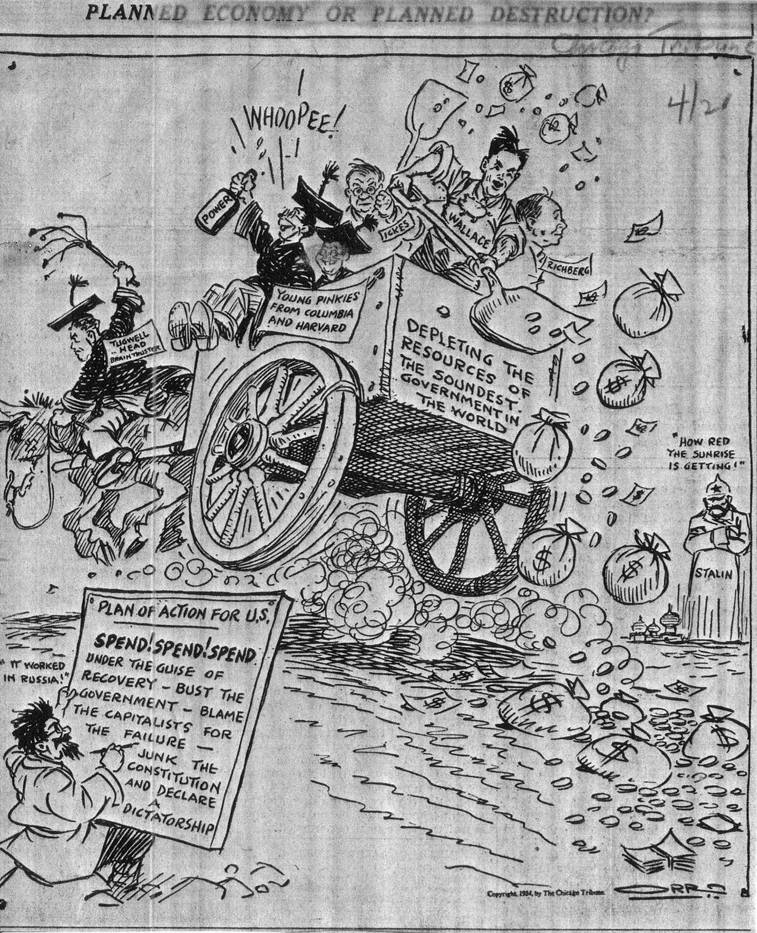
We clearly need to have the US Treasury and the Congress create an atmosphere of stability and discipline for our currency, even if it means going back to the gold standard. This is the only way to assure that we will establish a growing economy where business can take risk and be innovative while government must find ways to pay for the programs it develops without borrowing or printing money. Economic and market influences need to take center stage in government decision-making while politics is set aside. Richard Hoey of BNY Mellon tells us that the strongest economies in 2010 and 2011 will display three characteristics:
1. public policy which places high priority on economic growth relative to other objectives
2. no significant debt overhang
3. rising productivity of the workforce due to the diffusion of modern technology and business practices.
Will the US display these characteristics and grow the economy? It is my opinion given what is going on in European countries such as Portugal, Ireland, Italy, Greece and Spain with their government debt, high unemployment rates and restrictive government policies, that the US will fare well in its economic growth when compared to other economies globally in spite of our government’s inaction in setting forth tax structure and regulation which will stimulate business. Our economic momentum should be strong enough to move upward while government continues to present economic road blocks. This is a short-term prospective on my part. We will likely see economic growth, but at a slower rate than is usual for recovery from recession cycles historically. Our ability to sustain a growth pattern will depend heavily on a renewal of government policy which is favorable to business and free market principles.
For the Record March 24, 2010
DOW 10,838.8
NASDAQ 2,400.72
S&P 500 1,168.18
Recommended reading: “How Capitalism Will Save Us” by Steve Forbes and Elizabeth Ames
 Leonesmoneymonitormonthly's Blog
Leave a comment